Showing posts with label Siberia. Show all posts

Thursday, September 15, 2011

Mirny : World’s Biggest Diamond Mine


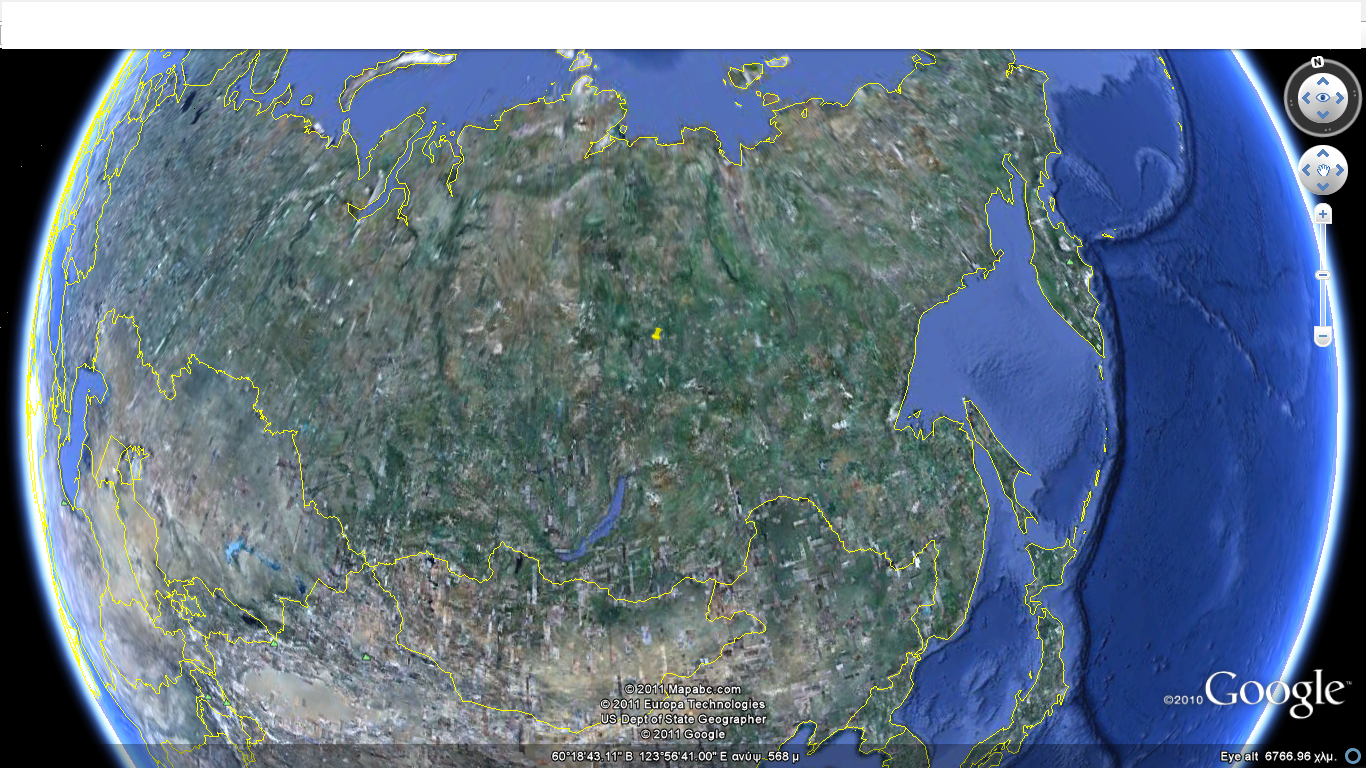
Mirny Mine is an open pit diamond mine located in Mirny, Eastern Siberia, Russia. The mine is 525 meters  deep (4th in the world) and has a diameter of 1,200 m and is the second largest excavated hole in the world, after Bingham Canyon Mine.

The mine is so big and giat that the airspace above the mine is closed for helicopters because of a few incidents in which they were sucked in by the downward air flow.
The mine was discovered on June 13, 1955 by Soviet geologists Yuri Khabardin, Ekaterina Elagina and Viktor Avdeenko during the large Amakinsky Expedition in Yakut ASSR. They found traces of volcanic rock kimberlite which are usually associated with diamonds.For this discovery, in 1957 Khabardin was given the Lenin Prize, which was one of the highest awards in the Soviet Union.


To give an idea how big it is here is is a fine illustration.


The development of the mine had started in 1957 in extremely harsh climate conditions. Seven months of winter per year froze the ground, which was hard in winter, but turned into sludge in summer. The entire mine had to be covered at night to prevent the machinery from freezing.


In the 1960s the mine was producing 10,000,000 carats (2,000 kg) of diamond per year, but the production rate slowed to 2,000,000 carats (400 kg) per year near the pit bottom. The largest diamond of the mine was found on 23 December 1980; it weighed 342.5 carats (68 g). The mine operation was interrupted in 1990s at a depth of 340 m after the pit bottom became flooded but resumed later.


The Mir mine was the first and the largest diamond mine in the Soviet Union. Its surface operation lasted 44 years, finally closing in June 2001. After the collapse of the USSR, in the 1990s, the mine was operated by the Sakha diamond company, which reported annual profits in excess of $600 million from diamond sales.


Currently, the mine is operated by Alrosa, the largest diamond producing company in Russia, and employs 3600 workers. It has long been anticipated that the recovery of diamonds by conventional surface methods will saturate. Therefore, in 1970s construction has started of a network of underground tunnels for diamond recovery. Production of diamonds by this method started in 1999 and is estimated to last for another 27 years. This estimate is based on depth explorations down to 1220 meters. In order to stabilize the abandoned main pit, its bottom was covered by a rubble layer 45 meters thick.

Thursday, August 25, 2011

Diomede Islands : Tomorrow and Yestarday


The Diomede Islands are two rocky islands located in the middle of the Bering Straitabout halfway between Russia and Alaska.


Despite being separated by just 3.8 kilometers, the Diomede Islands find themselves not only in different countries, but also twenty hours apart, due to the International Date Line passing between them. That's why the islands are sometimes called Tomorrow Island (Big Diomede) and Yesterday Isle (Little Diomede) because the time in Big Diomede is 20 hours (approximately a day) ahead of Little Diomede. Therefore, you can stand on the eastern island in Alaska and look into “tomorrow” in Russia.


Big Diomede is a part of the Russian Federation and is its easternmost point. Neighboring Little Diomede is part of Alaska. The islands were first populated by the Yupik peoples and used for hunting as long as 3,000 years ago, but Russian explorer Semyon Dezhnev was the first European to discover them in 1648.

It was eighty years before they were rediscovered by Danish navigator Vitus Bering on August 16th, 1728, celebrated in the Russian Orthodox church as the day honoring the Martyr St. Diomede. For many years, both islands had a small native population, but the population was eventually forced off of Big Diomede because of the Cold War. It is now unpopulated and the only structure in use on the island is a Russian weather station.


During the Cold War, the relationship between the two superpowers chilled, but the 'Ice Curtain' did not stop Lynne Cox from swimming between the islands in 1987, where she was congratulated by both Mikhail Gorbachev and Ronald Reagan. In 1997, comedian and television presenter Michael Palin visited the island at the start of his television show Full Circle. 


Little Diomede has a small town, Diomede (or Ignaluk), with a population of approximately 170, over 90 percent of which are Native Americans. The islanders are famous for their ivory carvings and the city functions as a wholesaler for the carvings, which are sold in Fairbanks and Anchorage as well as on the internet.


In the last few decades some factions have discussed the construction of a bridge over the strait, however, financial and weather concerns have continually stalled the project. Recently, talk of a tunnel under the strait has been on the front-burner, however, the high cost of same will certainly be a factor.