Thursday, September 08, 2011

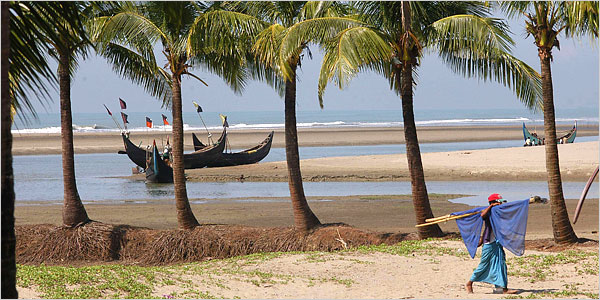
Cox's Bazar : 125 kilometres of sandy beach


Cox’s Bazar, with its incredible 125 km length, is the world’s longest natural sandy sea beach in the world and is situated in a district in the Chittagong Division of Bangladesh near the border of Myanmar.


Cox’s Bazar is the most visited tourist destination in Bangladesh.


Cox’s Bazar is also known by the name "Panowa", the literal translation of which means "yellow flower". Its other old name was "Palongkee". The modern Cox's Bazar derives its name from Captain Cox (died 1799), an officer serving in British India.


Cox's Bazar is visited by a large number of tourists from Britain, America, Korea, Japan, India, Nepal, Pakistan and many other countries each year. Though there is no record kept by the Bangladesh Porjatan Corporation (BPC) on how many people visit the beach annually, an AFP report says that during the winter there can be 10,000 available rooms in the beach area. Accommodations near the beach range from expensive high-end resorts to more reasonable options. Many private hotels, BPC Motels and two "Five star" hotels are located on or near the beach.


The sand at Cox's Bazar beach and surrounding areas is rich in heavy-metal mineral content. The heavy minerals of Cox's Bazar beach sands are dominated by hornblende, garnet, epidote, ilmenites (both unaltered and altered) with magnetite, rutile, pyrite and some hydroxides.


Due to lack of development, publicity and mismanagement; the spot hasn't become a most desirable international tourist destination. Cox’s Bazar now is competing to get top for “New7Wonders of Nature”.

Wednesday, September 07, 2011

Salar de Uyuni : the world’s largest mirror in the world


Salar de Uyuni is the world's largest salt flat at 10,582 square kilometers (4,086 sq mi). It is located in the Potosí and Oruro departments in southwest Bolivia, near the crest of the Andes, and is elevated 3,656 meters (11,995 ft) above the mean sea level.


The Salar was formed as a result of transformations between several prehistoric lakes. It is covered by a few meters of salt crust, which has an extraordinary flatness with the average altitude variations within one meter over the entire area of the Salar. The crust serves as a source of salt and covers a pool of brine, which is exceptionally rich in lithium. It contains 50 to 70% of the world's lithium reserves, which is in the process of being extracted.


The reflections offered are fascinating and the scenery seems to be surrealalien. Even when it rains and there is water in the lake,becomes the largest mirror of our planet.


One major tourist attraction is an antique train cemetery. It is 3 kilometers (1.9 mi) outside Uyuni and is connected to it by the old train tracks. The town served in the past as a distribution hub for the trains carrying minerals enroute to Pacific Ocean ports. The trains were mostly used by the mining companies. In the 1940s, the mining industry collapsed, partly because of mineral depletion. Many trains were abandoned, producing the train cemetery. There are proposals to build a museum from the cemetery.


Because the Salar de Uyuni is so flat, NASA is able to utilize it to calibrate some of their satellites. While the Salar de Uyuni itself is devoid of wildlife, it is used as the breeding grounds for some species of pink South American flamingos once a year in November. 


Here is an amazing video from a motorcycle in Salar de Uyuni